When securing heavy loads for transportation or storage, the right strapping material can make a significant difference to load stability. For palletized goods, lumber, construction materials, metal products, and other industrial loads, 5/8-inch (16 mm) PET strapping provides a practical combination of high strength, tension retention, and ease of handling.
PET strapping is made from polyethylene terephthalate and is widely used as an alternative to steel strapping in applications where high load-securing performance is required without the weight, corrosion, and sharp edges associated with steel.
This 5/8-inch industrial-grade PET strapping coil is designed for medium- to heavy-duty packaging applications and can be supplied in specifications suitable for manual, semi-automatic, and automatic strapping systems.
Product Overview & Specifications
The 5/8-inch PET strap, also known as 16 mm polyester strapping, is commonly used for demanding industrial packaging applications.
A typical specification for this product is:
- Width: 5/8 inch (16 mm)
- Thickness: 0.035 inch
- Break strength: 5,020 N ~ 5,650 N
- Coil length: up to 3,800 ft
- Core: 16 × 6 inches
- Material: PET (polyethylene terephthalate)
- Surface: smooth or embossed
- Color: commonly green, with other colors available depending on requirements
The exact specifications can vary according to the grade and intended application.
Among these specifications, break strength is one of the most important indicators of load-securing capability. However, it should not be considered in isolation. Strap width, thickness, elongation, tension retention, joint strength, and compatibility with the application all influence actual performance.
Why Use PET Strapping?
High Strength and Tension Retention
One of the main reasons PET is used for heavy-duty packaging is its high tensile performance.
A 5/8-inch PET strap with a break strength of 5,020 N ~ 5,650 N can provide the load-securing capacity required for many industrial applications. At the same time, PET can elongate during tensioning and recover part of that elongation afterward.
This elastic behavior is useful when loads settle or experience vibration during transportation. Rather than relying only on the initial tension applied during packaging, PET can maintain useful restraint as the load changes.
This is an important distinction between PET and PP strapping.
PP generally has higher elongation and is more flexible, making it well suited to cartons and lighter loads. PET is more rigid and generally provides better tension retention under sustained load.
For heavy or rigid products, that difference can be significant.
Resistance to Moisture and Corrosion
PET does not rust or corrode like steel.
This makes it useful for products that may be stored outdoors or transported through environments where moisture is present. PET also provides good resistance to environmental exposure, although long-term performance depends on the specific grade and conditions.
For applications such as lumber, construction materials, and export shipments, avoiding steel corrosion can also help prevent staining or contamination of the packaged product.
PET should not be considered immune to environmental degradation. Prolonged exposure to intense UV radiation, high temperatures, or other harsh conditions can affect polymer performance over time. The appropriate grade should therefore be selected according to the actual storage and transportation environment.
Easier and Safer Handling
PET is considerably lighter than steel strapping and does not have the sharp metal edges associated with steel banding.
This makes PET easier to transport, handle, and apply in everyday packaging operations. Workers can handle coils without dealing with the weight and edge hazards of steel to the same extent.
However, PET strapping under tension still stores energy and must be cut and handled properly. The absence of sharp steel edges does not mean that safety procedures can be ignored.
For many operations, the combination of lower weight and easier handling is one of the practical reasons for switching from steel to PET.
Key Applications
The 5/8-inch PET strap format is suitable for a wide range of industrial packaging applications.
Palletizing and Unitizing
PET strap can be used to secure palletized goods and prevent products from shifting during handling, transportation, and storage.
It is particularly useful when the load requires more restraint than conventional PP strapping can provide.
Lumber and Wood Products
Timber, lumber, panel products, and other construction materials are commonly bundled with PET strapping.
The strap’s high strength and resistance to moisture make it suitable for products that may spend time outdoors or pass through different transportation environments.
Metals and Steel Products
PET can be used for certain metal products, including steel and aluminum components, sheets, pipes, and other bundled products.
For applications where steel strapping has traditionally been used, PET can provide a lighter alternative when its available strength is sufficient for the load.
Construction Materials
Bricks, concrete blocks, pipes, tiles, and other construction products often require reliable bundling during transportation.
PET provides the tension and restraint needed for many of these applications while avoiding corrosion-related problems.
Export Shipments
Long-distance shipments can expose packaged products to vibration, temperature changes, handling impacts, and extended storage.
PET’s combination of strength and tension retention makes it suitable for many export packaging applications.
PET vs. Steel Strapping
PET and steel both have important roles in industrial load securement.
Steel provides extremely high strength and remains necessary for some demanding applications. PET, however, offers several practical advantages where its strength is sufficient.
PET is significantly lighter, does not rust, and has no sharp steel edges. It can also absorb some impact during transportation rather than behaving as a completely rigid metal band.
The comparison should therefore be based on the requirements of the particular load rather than simply asking which material is stronger.
If the application requires extremely high strength, high-temperature resistance, or other specialized characteristics, steel may remain the appropriate choice.
If the required load restraint can be achieved with PET, the lower weight, corrosion resistance, and easier handling can make PET an attractive alternative.
How to Choose the Right 5/8-Inch PET Strap
Choosing the right strap involves more than selecting a width.
Hand Grade or Machine Grade?
Hand-grade PET strapping is intended for manual tensioner & sealer, pneumatic or battery-powered combination strapping tools.
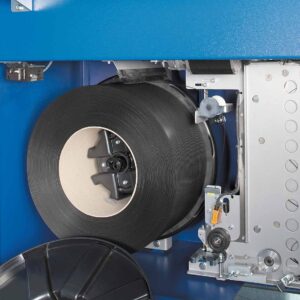
Machine-grade PET strapping is manufactured for automatic strapping systems. These applications require consistent dimensions and winding so that the strap can feed, tension, cut, and weld reliably.
A strap can have high break strength and still perform poorly on an automatic line if the dimensions or winding quality are inconsistent.
Check the Coil Specification
Before ordering, confirm:
- Width and thickness
- Break strength
- Coil length
- Core diameter
- Coil dimensions
- Strap grade
- Surface finish
- Color
- Machine compatibility
The core and coil dimensions are particularly important for automatic equipment because the roll must physically fit the dispenser and feeding system.
Consider the Application
Don’t automatically choose the thickest or strongest strap available.
Consider the weight and characteristics of the load, how the load is arranged, how much tension is required, transportation distance, storage conditions, and the equipment used to apply the strap.
A correctly specified strap can provide sufficient load security without unnecessarily increasing material costs.
The 5/8-inch industrial-grade PET strapping is a practical choice for many medium- to heavy-duty packaging applications.
With a typical break strength of around 5,020 N, PET provides high load-securing performance while offering advantages such as lower weight, corrosion resistance, easier handling, and good tension retention.
It is commonly used for palletized goods, lumber, construction materials, metal products, export shipments, and other industrial loads.
For buyers, however, the key is not simply finding the strongest PET strap available. The strap needs to match the load, application, and packaging equipment.
The right PET strapping is the one that provides sufficient strength, maintains reliable restraint, and performs consistently from the first coil to the last.