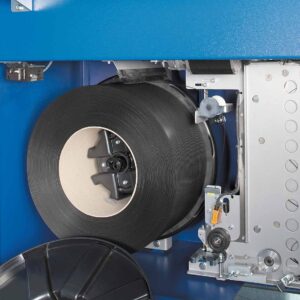
A fully automatic strapping machine applies a plastic strap around a package, tensions the strap, seals it, cuts it, and prepares for the next cycle with minimal operator intervention. It is designed for packaging operations where products arrive at a consistent workstation or production line and repeated strapping is required.
For businesses handling cartons, boxes, bundles, and other standardized loads, automatic strapping can reduce repetitive manual work and make the packaging process more consistent.
But choosing an automatic strapping machine is not simply a matter of looking at cycle speed. Package dimensions, strap specifications, required tension, production volume, machine configuration, and line integration all need to be considered.
What Is a Fully Automatic Strapping Machine?
A fully automatic strapping machine is a packaging machine designed to secure a package with plastic strapping through an automated cycle.
Depending on the machine configuration, the basic process includes:
- Positioning the package in the strapping area
- Feeding the strap around the package
- Detecting the strap position
- Tensioning the strap
- Heat-sealing the strap
- Cutting the strap
- Returning the mechanism to its starting position
The operator’s role depends on the packaging line. On a standalone machine, an operator may still need to place and remove packages. In a conveyor-based system, the machine can be incorporated into a more automated packaging process.
The YS-101, for example, uses PP machine strapping and automatically completes the strapping cycle after the package is positioned against the stopper and the strap is inserted into the strap inlet. Its standard arch is 800 × 600 mm.
How Does an Automatic Strapping Machine Work?
Although the internal mechanism varies between machine models, the operating principle is relatively straightforward.
1. The package enters the strapping position
The package needs to be positioned correctly within the machine’s working area.
For the YS-101, the manual specifies that the package should be placed on the worktable against the stopper before strapping begins.
Correct positioning matters because the package must remain within the machine’s working and arch dimensions.
2. The strap is fed around the package
The machine uses a reel of PP machine strap. The strap travels through the feeding mechanism and into the strapping head.
Proper strap loading and threading are important. The manufacturer specifically notes that incorrect strap threading can cause machine operation failure.
3. The strap is tensioned
Once the strap has been positioned around the package, the machine applies tension.
The YS-101 has an adjustable tension range of 0–60 kg. The appropriate setting depends on the package and the strap being used.
More tension is not automatically better.
Excessive tension can damage the strap or the package, while insufficient tension can result in a loose strap.
4. The strap is heat sealed
After tensioning, the machine uses a hot-melt sealing process to join the PP strap.
The YS-101 uses bottom adhesion with a hot-melt method. The manual specifies an adhesive surface of at least 90%, an adhesive width of at least 20%, and adhesive-position deviation of no more than 2 mm.
This is one reason why temperature adjustment and the condition of the heater assembly are important to machine performance.
5. The strap is cut and the machine resets
After the strap has been sealed, the mechanism cuts the strap and returns to its operating position.
The machine can then begin another cycle.
This repeated sequence is what makes automatic strapping particularly useful for repetitive packaging operations.
What Strap Does a Fully Automatic Strapping Machine Use?
Not every plastic strap is suitable for every automatic strapping machine.
The strap needs to match the machine’s feeding, tensioning, sealing, and cutting mechanisms.
For the YS-101, the documented strap requirements are:
| Parameter | YS-101 |
|---|---|
| Strap material | PP |
| Strap width | 9–15 mm |
| Strap thickness | 0.55–1.0 mm |
| Reel width | 160–180 mm |
| Reel inner diameter | 200–210 mm |
| Reel outer diameter | 400–500 mm |
| Strap length per reel | 2,000–4,000 m |
These specifications are specific to the YS-101 and should not automatically be applied to every automatic strapping machine.
This is an important point when purchasing equipment: the machine and strap should be considered as one system.
How Fast Is a Fully Automatic Strapping Machine?
Machine speed is usually one of the first specifications buyers look at.
The YS-101 has a documented packing speed of up to 2.5 seconds per cycle under the conditions specified by the manufacturer.
However, quoted cycle speed should not be confused with actual production throughput.
Real-world output can also depend on:
- Package dimensions
- Package positioning
- Conveyor speed
- Operator handling
- Product flow
- Number of straps required per package
- Machine configuration
- Strap feeding conditions
If packages need to be manually positioned and removed, for example, the machine’s theoretical cycle time will not represent the complete packaging process.
What Packages Can an Automatic Strapping Machine Handle?
Machine selection should begin with the package rather than the machine.
For the YS-101, the documented minimum package size is 80 × 100 mm, while the maximum package dimensions are limited by the arch.
The standard arch is 800 × 600 mm.
The manual also cautions against using the machine for wet, powdery, dusty, or excessively heavy packages and indicates a usual maximum load of 80 kg for the stated application.
Therefore, before selecting a machine, measure the products that will actually be strapped.
At minimum, record:
- Package length
- Package width
- Package height
- Package weight
- Product rigidity
- Required number of straps
- Desired strap tension
These measurements will help determine whether a standard machine is appropriate or whether a customized configuration is necessary.
Fully Automatic vs. Manual Strapping
The biggest difference is not simply speed.
It is how much of the packaging process depends on the operator.
With manual strapping, the operator performs most of the process.
With an automatic machine, the machine takes over repetitive operations such as strap feeding, tensioning, sealing, and cutting.
This can provide several advantages in a high-volume packaging environment:
- Less repetitive operator work
- More consistent strap application
- Faster repeated cycles
- Easier integration into production lines
- More predictable packaging processes
However, automation also introduces additional considerations, including machine investment, installation, maintenance, electrical requirements, and compatibility between the machine and the packaging process.
For lower-volume operations, a semi-automatic machine may still be the more practical choice.
What Should You Check Before Buying?
Before purchasing a fully automatic strapping machine, don’t start with the price.
Start with your packaging process.
1. Package dimensions
Measure the smallest and largest packages you need to strap.
2. Package weight
Check whether the machine’s working capacity matches your actual products.
3. Strap specifications
Confirm the required strap material, width, thickness, reel dimensions, and sealing method.
4. Required tension
Different products require different levels of strap tension. The machine should provide enough adjustment range for your application.
5. Production volume
Calculate how many packages need to be strapped per hour or per shift.
Automation becomes more attractive as repetitive workload increases.
6. Machine integration
If packages already move on conveyors, check whether the machine can be integrated into the existing line.
7. Installation conditions
Check the available floor space, electrical supply, working environment, and machine access for maintenance.
For the YS-101, the documented installation environment is 0–40°C with relative humidity of no more than 90%. The manual also specifies a minimum installation space of 2,000 × 1,500 mm and calls for a flat, dry, hard floor and suitable electrical supply.
Common Problems With Automatic Strapping Machines
Automatic machines reduce manual work, but they still require correct setup and maintenance.
Common problems include:
- Strap not feeding correctly
- Strap not reaching the correct position
- Poor heat-seal adhesion
- Loose strap after tensioning
- Strap breaking during tensioning
- Machine failing to start
- Inconsistent strap feeding
The cause is not always a failed machine component.
For example, the YS-101 troubleshooting section identifies strap width, thickness, and bending quality as possible causes of feeding problems. It also identifies incorrect tension adjustment, worn clamp components, strap scraps in the clamp teeth, damaged springs, and damaged bearings as possible causes of tensioning problems.
This is why troubleshooting should consider both machine condition and strap quality.
See our upcoming Automatic Strapping Machine Troubleshooting Guide for a detailed breakdown of common faults and possible causes.
Automatic Strapping Machine Maintenance
Maintenance is part of machine performance, not an afterthought.
The manufacturer recommends keeping the machine and its components clean, lubricating specified components regularly, and inspecting electrical equipment.
The manual also specifies lubrication points and warns that certain components, including the strap conveying roller, must remain free of oil.
Maintenance should therefore follow the machine manufacturer’s instructions rather than applying lubricant indiscriminately.
A basic maintenance program should include:
- Cleaning the strapping head
- Inspecting strap paths
- Checking moving components
- Inspecting the heater assembly
- Checking tensioning components
- Removing strap scraps
- Lubricating specified components
- Inspecting electrical components
- Checking fasteners and mechanical connections
For machines operating under heavy workloads, preventive maintenance becomes particularly important.
Is a Fully Automatic Strapping Machine Right for Your Operation?
A fully automatic strapping machine makes the most sense when strapping is a repetitive part of your packaging process.
It is particularly worth considering when you have:
- Consistent package sizes
- Repetitive production
- High packaging volume
- A need to reduce manual handling
- A conveyor-based production line
- A requirement for consistent strap application
For lower production volumes or highly variable package sizes, a semi-automatic machine may be more appropriate.
The right question is therefore not:
“Which machine is the most automatic?”
It is:
“Which level of automation fits our actual packaging process?”
Final Buying Checklist
Before requesting a quotation, prepare the following information:
- Product type
- Package dimensions
- Package weight
- Packages per hour
- Number of straps per package
- Required strap material
- Strap width and thickness
- Required tension
- Current packaging process
- Conveyor information, if applicable
- Available electrical supply
- Available installation space
The more complete this information is, the easier it is for a machine supplier to recommend an appropriate configuration.
Looking for a Fully Automatic Strapping Solution?
If you’re evaluating an automatic strapping machine for a new production line or replacing an existing packaging process, we can help you match the machine configuration with your package dimensions, PP strap specifications, and production requirements.
Request a Quote and send us your package size, weight, required strap, and expected packaging volume.