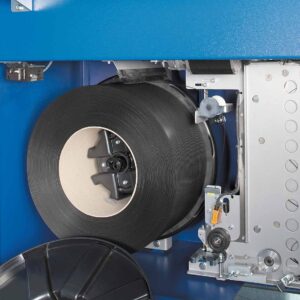
If you’ve ever visited a warehouse or production line, you’ve probably noticed rolls of polypropylene strapping beside the packing stations. It’s one of those packaging materials that rarely gets much attention—until a shipment arrives with broken straps or an unstable pallet.
Polypropylene strapping, often called PP strapping, has become the standard solution for securing cartons, bundling products, and stabilizing pallet loads. It’s lightweight, economical, and compatible with both manual tools and fully automatic strapping machines. For businesses shipping light to medium-weight products, it offers a reliable balance between performance and cost.
But not all PP strapping is the same. Width, thickness, tensile strength, embossing, and even the quality of the raw material can affect how well it performs. Choosing the right specification can reduce packaging costs, improve productivity, and minimize damaged shipments.
This guide explains what polypropylene strapping is, how it’s manufactured, where it’s used, and how to select the right type for your packaging operation.
What Is Polypropylene Strapping?
Polypropylene strapping is a plastic packaging strap made from polypropylene resin, a durable thermoplastic that combines flexibility with good tensile strength. Once the resin is melted and extruded, it is stretched under controlled conditions to improve its strength before being embossed or finished with a smooth surface and wound into rolls.
Because of its relatively low cost and easy handling, PP strapping has become the preferred choice for many everyday packaging applications. It’s commonly used to secure cardboard cartons, bundle printed materials, organize building supplies, and stabilize pallet loads before storage or transportation.
Unlike steel strapping, polypropylene won’t rust or leave sharp edges after cutting. Compared with polyester strapping, it is generally more economical and better suited to lighter loads. That’s why you’ll often find PP strapping in e-commerce warehouses, food packaging facilities, printing companies, and distribution centers where speed and efficiency matter.
Where Is Polypropylene Strapping Used?
One reason polypropylene strapping is so widely adopted is its versatility. It performs well across a broad range of industries and packaging environments.
Typical applications include:
- Corrugated carton packaging
- E-commerce order fulfillment
- Newspaper and magazine bundling
- Food and beverage packaging
- Pharmaceutical products
- Textile and garment packaging
- Electronics and consumer goods
- Warehouse palletizing
- Building materials
- Agricultural products
For lightweight cartons or medium-duty pallet loads, PP strapping usually provides all the holding power required without the additional cost of heavier-duty materials.
Why Businesses Choose PP Strapping
Price is often the first reason companies choose polypropylene strapping, but it’s far from the only one.
It Keeps Packaging Costs Under Control
For products that don’t require extremely high tension, PP strapping delivers dependable performance at a lower material cost than polyester or steel strapping. That makes it a practical option for businesses shipping large volumes of cartons every day.
It’s Easy to Handle
PP strapping is flexible enough to wrap around square, round, or irregular packages without damaging product corners. Operators can apply it quickly using manual tools, semi-automatic machines, or fully automatic systems.
It’s Safer Than Steel
Unlike steel strapping, polypropylene doesn’t rust or leave razor-sharp edges after cutting. This reduces the risk of workplace injuries and makes disposal easier.
It Works with Almost Any Packaging Line
Whether you’re packing a few dozen cartons a day or operating a high-speed production line, there’s a PP strapping solution to match. The same material can be used with handheld tools, tabletop machines, arch strapping machines, and fully automated packaging systems.
Choosing the Right Polypropylene Strap
Many buyers focus only on strap width, but that’s only one part of the equation. The right specification depends on your products, packaging equipment, and shipping conditions.
Before placing an order, consider these factors:
Strap Width
Common widths include:
- 5 mm
- 9 mm
- 12 mm
- 15 mm
- 16 mm
- 19 mm
A wider strap generally provides greater breaking strength, but using an oversized strap for lightweight cartons often increases packaging costs without adding meaningful protection.
Strap Thickness
Thickness affects both tensile strength and elongation.
Typical options range from 0.45 mm to 1.20 mm. A thicker strap isn’t always the better choice. Matching the thickness to your product weight and packaging method usually produces better results than simply selecting the strongest specification available.
Machine Compatibility
Not every PP strap works with every machine.
Hand-grade strapping is designed for manual tools, while machine-grade strapping is manufactured with tighter dimensional tolerances to ensure smooth feeding through semi-automatic and fully automatic equipment. Using the wrong type can lead to feeding problems, machine jams, and unnecessary downtime.
Shipping Conditions
If your products travel long distances or are frequently handled during transportation, consider how vibration and movement may affect strap tension. In some export applications, upgrading to a higher-quality PP strap—or switching to PET strapping for heavier loads—can improve load stability and reduce the risk of damage.